ISCStack™ Framework
Runtime Governance Architecture for Intelligent Systems
1. The Structural Problem
Autonomous systems do not fail because they lack intelligence.
They fail because execution outpaces control.
As systems transition from advisory tools to agentic infrastructure — triggering APIs, moving capital, modifying environments, and interacting with physical systems — governance can no longer exist in documentation, dashboards, or post-hoc audits.
Governance must exist where decisions become actions.
At the execution boundary.
ISCStack™ defines the runtime control grammar that governs how intelligence moves from proposal to commit — safely, legally, and accountably.
2. What ISCStack™ Is
ISCStack™ (Intelligent Systems Control Stack) is a layered runtime governance architecture.
It defines:
• How policy is translated into enforceable logic
• How decisions are verified before execution
• How authority is resolved at commit time
• How constraints are validated before action
• How embodied and distributed execution is structurally governed
ISCStack™ is not a model.
It is not a platform.
It is not a compliance checklist.
It is infrastructure doctrine.
3. The Runtime Control Plane
ISCStack™ operates inside the Runtime Control Plane — the operational layer responsible for:
• Decision verification
• Constraint validation
• Authority binding
• Pre-commit authorization
• Execution boundary enforcement
Governance must operate inside runtime — not outside it.
4. Unified Runtime Governance Architecture
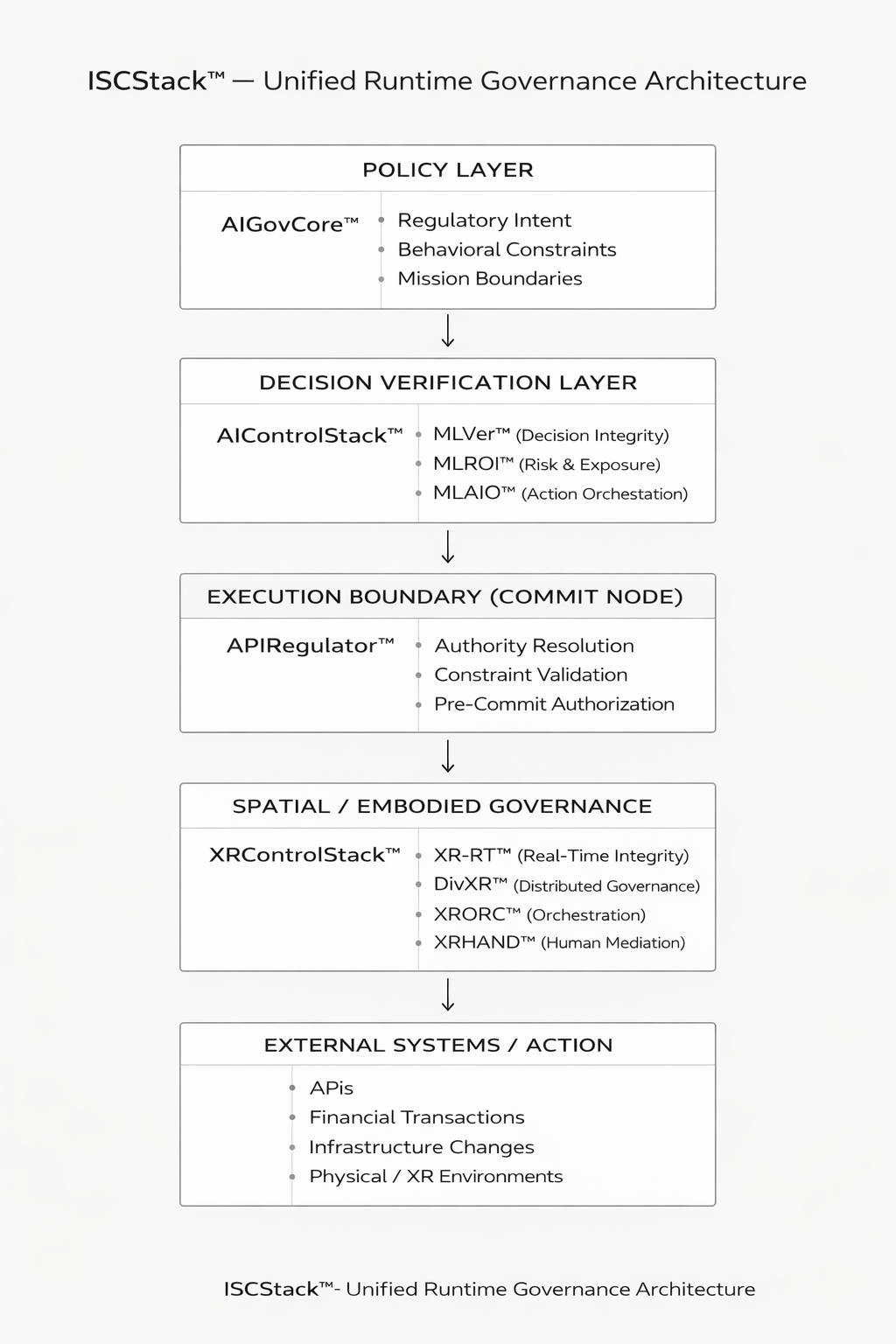
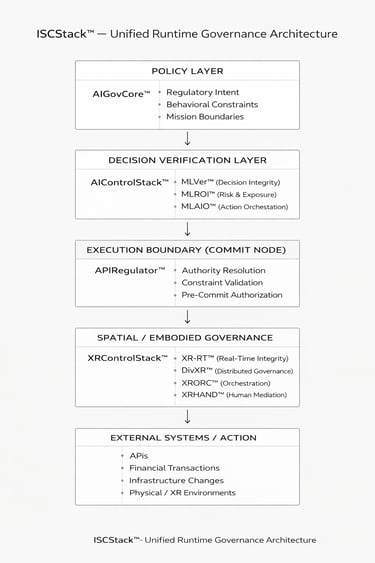
ISCStack™ — Proposal → Verification → Authorization → Commit → Consequence
This diagram illustrates how ISCStack™ integrates policy, intelligence verification, execution authorization, and embodied governance into a single structural pathway.
5. The Three Control Domains
ISCStack™ defines three structural governance domains.
Each governs a distinct risk surface.
Together, they form unified runtime enforcement.
5.1 AIControlStack™
Internal Decision Integrity & Verification
AIControlStack™ governs intelligence before execution.
It ensures decisions are structurally admissible before action.
Infrastructure Layers:
• MLVer™ — Decision integrity validation
• MLROI™ — Runtime risk and outcome evaluation
• MLAIO™ — Controlled action orchestration
AIControlStack™ ensures intelligence cannot act outside verified constraints.
5.2 ISCGovernance™
Policy Enforcement at the Execution Boundary
ISCGovernance™ governs legality, mission scope, and regulatory compliance.
It ensures non-compliant execution is structurally impossible.
Infrastructure Layers:
• AIGovCore™ — Policy definition & regulatory logic
• MLRegulator™ — Compliance mediation layer
• APIRegulator™ — Pre-commit enforcement & boundary interception
ISCGovernance™ transforms compliance from documentation into architecture.
5.3 XRControlStack™
Spatial & Real-Time Governance for Embodied Systems
XRControlStack™ governs execution in distributed, immersive, and physical environments.
Where consequences materialize beyond digital systems.
Infrastructure Layers:
• DivXR™ — Distributed spatial governance
• XRORC™ — Environmental orchestration control
• XR-RT — Real-time integrity enforcement
• XRHAND™ — Human-system mediation
XRControlStack™ ensures embodied intelligence remains structurally constrained.
6. Regulation by Architecture
Most governance systems assume control exists outside execution.
ISCStack™ embeds control inside execution.
Instead of:
• Auditing after harm
• Explaining failure
• Monitoring behavior post-action
ISCStack™ ensures:
• Unauthorized actions cannot execute
• Illegal behavior is structurally blocked
• Authority is resolved at commit
• Accountability is encoded at runtime
Governance becomes executable.
7. Foundational Question
The question is no longer:
“How intelligent can systems become?”
The question is:
“Who is allowed to let them act?”
ISCStack™ defines that answer structurally.
FAQs
What is iscstack™?
iscstack™ is a runtime governance architecture embedding policy enforcement and decision verification inside intelligent systems.
What problem does it solve?
It addresses the challenge of ensuring trusted, controlled execution and compliance within complex AI-driven environments.
How does iscstack™ work?
iscstack™ integrates policy enforcement and execution boundary controls directly into intelligent systems, allowing real-time governance and decision verification.
Who benefits from iscstack™?
Organizations using AI systems that require trustworthy, auditable, and controlled operations gain the most benefit.
Is iscstack™ easy to implement?
Yes, iscstack™ is designed for seamless integration within existing intelligent system architectures.
Where can I learn more about iscstack™?
Visit our documentation and contact our team for detailed insights and tailored support on iscstack™ implementation.
Address
Cairo, Egypt
Contacts
+201099442720
Info@iscstack.com
Subscribe to our newsletter
ISCStack™ — Runtime Governance as Architecture
© 2026 ISCStack™. All rights reserved.
ISCStack™ — Intelligent Systems Control Stack.
Runtime governance architecture for autonomous and embodied systems.